
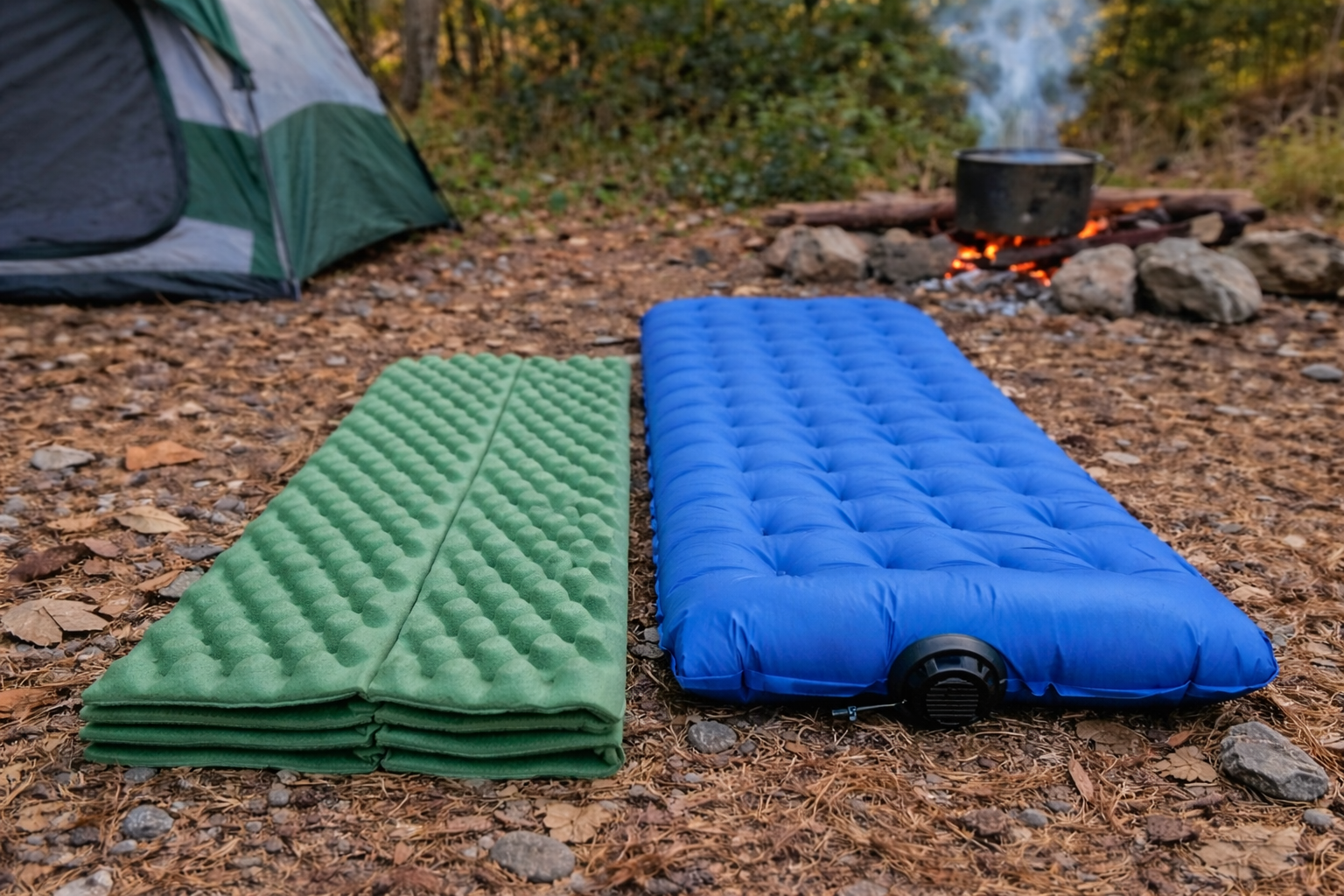
If you’re trying to decide between a Foam sleeping pad vs inflatable (budget), you’re already asking the right question. This choice matters way more than most people expect—especially when you’re camping on a budget and every piece of gear has to pull its weight.
I’ve slept on both styles more times than I can count. Some nights were totally fine. Others… not so much 😅. And almost every bad night came down to picking the wrong type of pad for the situation—not necessarily buying a “cheap” one.
This guide breaks down foam vs inflatable sleeping pads strictly from a budget camper’s perspective. No brand hype. No product pushing. Just real-world differences, trade-offs, and when each option actually makes sense 🌲🏕️
Table of Contents
- Foam vs inflatable: the short answer
- My quick lesson learned the hard way
- Comfort differences (side sleepers vs everyone else)
- Warmth and insulation on a budget
- Durability and failure risk
- Pack size, weight, and convenience
- Noise, movement, and sleep quality
- Cost reality: where budget pads shine and fail
- Which type is better for different camping styles
- How to make any cheap sleeping pad work better
- Summary + what to read next
Foam sleeping pad vs inflatable (budget): the short answer
If you just want the quick takeaway:
- Foam sleeping pads are more reliable, warmer per dollar, and nearly impossible to “fail.”
- Inflatable sleeping pads are more comfortable and pack much smaller, but come with more risk and setup time.
Neither one is objectively better. The best option depends on how you sleep, where you camp, and how much hassle you’re willing to deal with at night.
My quick lesson learned the hard way
My first real budget camping trip, I brought a thin foam pad that felt totally fine at home. I figured, “It’s camping, it doesn’t have to be perfect.”
That trip taught me something important:
cheap doesn’t mean bad—but the wrong type of pad will always feel bad.
Comfort: foam vs inflatable sleeping pads (budget)
Inflatable pads usually feel more comfortable
This is the biggest reason people lean inflatable.
Even budget inflatables:
- Provide more cushioning for hips and shoulders
- Feel better for side sleepers
- Reduce pressure points on hard ground
If comfort is your top priority, inflatables usually win here.
Foam pads feel firmer and more “grounded”
Foam pads don’t cradle your body the same way. You feel the ground more—especially on rocky or packed dirt sites.
That doesn’t mean foam is unusable. It just means:
- Back sleepers often tolerate foam better
- Softer campsites matter more
- Comfort depends heavily on site selection
Small tip: foam feels noticeably better on forest duff, grass, or sand than on gravel or hardened pads.
Warmth and insulation (where foam shines on a budget)
When temperatures drop, insulation matters more than thickness.
Foam pads insulate consistently
Foam naturally traps air and doesn’t shift around during the night. That makes it:
- Predictable
- Reliable
- Surprisingly warm for the price
This is why foam pads are often recommended for colder ground, even when they’re thin.
Budget inflatables can sleep colder
Many budget inflatables focus on comfort, not insulation. Without internal insulation, cold ground can pull heat away from you faster than expected.
That’s not always a problem in warm weather—but it can be noticeable on cooler nights.
Budget trick that works:
Foam pad underneath + inflatable on top = warmer and more comfortable than either one alone 🔥
Durability and failure risk
Foam pads almost never fail
Foam pads:
- Can’t leak
- Don’t need valves
- Don’t care about thorns, gravel, or sticks
Worst case, they slowly compress over years. They don’t ruin your night suddenly.
Inflatable pads can fail instantly
Inflatables are tougher than they used to be, but at budget prices:
- Small punctures happen
- Valve issues happen
- Seams can fail
Most nights are fine… until one isn’t.
That doesn’t mean inflatables are bad—it just means they require more care.
Here’s a simple, real-world comparison based on budget options—not premium gear.
| Feature | Budget Foam Sleeping Pad | Budget Inflatable Sleeping Pad |
|---|---|---|
| Comfort | Firm, supportive feel | Softer, more cushioned |
| Best sleeping position | Back & stomach sleepers | Side sleepers |
| Warmth per dollar | Very good (natural insulation) | Varies (can feel colder) |
| Cold ground performance | Consistent | Depends on insulation |
| Pack size | Bulky | Packs very small |
| Weight | Light but awkward | Usually lighter & compact |
| Setup time | Instant | Requires inflation |
| Durability | Extremely high | Moderate (puncture risk) |
| Failure risk | Very low | Sudden failure possible |
| Noise & movement | Silent, stable | Can crinkle or bounce |
| Best for | Reliability & simplicity | Comfort & compact packing |
Quick takeaway:
If you value reliability and warmth on a tight budget, foam usually wins. If comfort and pack size matter more—and you’re willing to be a little careful—budget inflatables make sense.
Pack size, weight, and convenience
Inflatable pads pack much smaller
This is where inflatables clearly win:
- Easier to fit inside a backpack
- Better for travel and minimalist setups
- Less awkward than strapping foam outside a pack
Foam pads are bulkier (even when light)
Foam pads can be light, but they’re bulky. You’ll usually:
- Strap them to the outside of your pack
- Carry them by hand for car camping
- Deal with snagging branches on trail
For car camping, this doesn’t matter much. For backpacking, it can.
Noise, movement, and sleep quality
This part doesn’t get talked about enough.
Inflatable pads can be noisy
Some inflatables:
- Crinkle when you move
- Bounce a little if overinflated
- Shift if the tent floor is slick
Not always a dealbreaker—but noticeable if you’re a light sleeper.
Foam pads stay quiet and put
Foam pads:
- Don’t make noise
- Don’t bounce
- Don’t shift much
They feel more “stable,” even if they’re firmer.
Cost reality: what budget actually means here
At lower price points:
- Foam pads tend to be more consistent
- Inflatable pads vary more in quality
You can absolutely find good budget inflatables—but the margin for error is smaller.
That’s why many experienced budget campers:
- Start with foam
- Add an inflatable later
- Or layer both when conditions demand it
Which is better for different camping styles?
Car camping
- Foam pads work great
- Bulk doesn’t matter
- Reliability matters more than pack size
Backpacking on a budget
- Inflatable pads are easier to pack
- Foam pads still work if you don’t mind bulk
- Layering can be smart for cold trips
Cold weather or shoulder seasons
- Foam has a clear advantage
- Layering foam + inflatable works extremely well
If you’re also dialing in your cold-weather setup, this pairs well with Best Sleeping Bags Under $50 for Cold Weather—it helps match your insulation properly so you’re not blaming the pad for a bag issue.
Festivals, road trips, backup sleep setups
- Foam is easy, durable, and stress-free
- No inflation, no worrying about damage
How to make ANY cheap sleeping pad work better
These tips matter more than upgrading gear:
1. Choose your campsite carefully
Clear rocks, pinecones, and roots. Even a great pad feels bad on terrible ground.
2. Don’t overinflate
Slightly softer inflatables reduce pressure points and bounce.
3. Layer when needed
Foam under inflatable =
- Warmer
- More comfortable
- Better protection
4. Use a simple groundsheet
It reduces abrasion and extends the life of budget inflatables.
5. Accept realistic expectations
Budget pads won’t feel like a home mattress—and that’s okay. The goal is restful enough sleep, not luxury.
Summary + what to read next
When it comes to Foam sleeping pad vs inflatable (budget), the smartest choice depends on your priorities:
- Choose foam if you want warmth, reliability, and simplicity
- Choose inflatable if you want comfort and a smaller pack
- Combine both if you want the best budget performance overall
If you’re ready to move from theory to actual buying decisions, this comparison pairs well with Best Sleeping Pads Under $30, where comfort, warmth, and value are broken down into real budget-friendly options.
This is especially worth it if you’re trying to avoid buying twice—or waking up at 2 a.m. wondering why the ground suddenly feels harder than it did at bedtime 😴🌲
Post Disclaimer
This site contains affiliate links (including Amazon) and uses Google AdSense. Purchases through links may earn a commission at no extra cost to you. Ads may be personalized.