
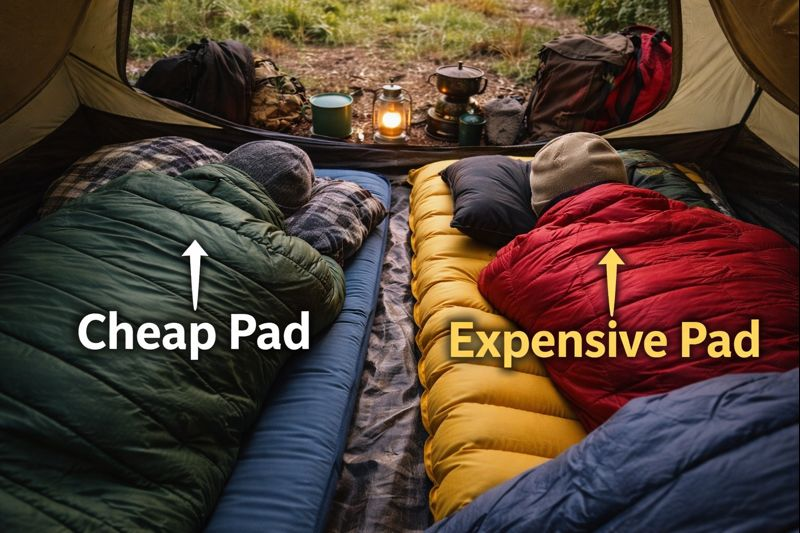
If you’ve ever stood in an outdoor store staring at sleeping pads, you know the feeling. One pad costs $25, another costs $180, and they both promise “comfort” and “great insulation.” The question is simple but annoying: Cheap vs Expensive Camping Sleeping Pads — is the price difference actually worth it?
I’ve slept on both ends of the spectrum. Thin foam pads that felt like yoga mats, inflatable pads that slowly leaked air by 2 a.m., and pricier models that made me forget I was sleeping on rocky ground. The truth is, cheap and expensive sleeping pads both have their place — you just need to know what you’re trading off.
Let’s break it down honestly, without the marketing fluff.
Table of Contents
- Cheap vs Expensive Camping Sleeping Pads: What’s the Real Difference?
- Materials & Build Quality
- Comfort & Sleep Quality
- Insulation & R-Value Explained
- Durability and Longevity
- Pack Size & Weight
- Price vs Performance Comparison Table
- Pros and Cons of Cheap Sleeping Pads
- Pros and Cons of Expensive Sleeping Pads
- Who Should Buy Cheap Pads
- Who Should Buy Expensive Pads
- Final Verdict: Which One Makes Sense for You?
Cheap vs Expensive Camping Sleeping Pads: What’s the Real Difference?
At a glance, the difference looks like price and brand name. In reality, it comes down to materials, insulation, comfort design, and long-term reliability.
Cheap sleeping pads focus on basic functionality. They keep you off the ground and that’s about it. Expensive pads aim to do more — better warmth, quieter materials, and consistent support through the night.
Neither is “wrong,” but they’re built for different campers.
Materials & Build Quality
Cheap sleeping pads usually use thinner fabrics and simpler internal construction. That’s how they keep costs down. Most budget inflatable pads rely on basic air chambers without much structure.
Expensive sleeping pads tend to use:
- Stronger ripstop fabrics
- Multi-layer air chambers
- Better welds and seams
- Quieter materials (huge bonus if you move around at night)
This doesn’t mean cheap pads always fail, but they do feel more… delicate. I’ve definitely treated budget pads like glass compared to pricier ones 😅.
Cheap vs Expensive Camping Sleeping Pads: Comfort & Sleep Quality
This is where the gap starts to show.
Cheap pads usually offer:
- Minimal thickness (1–2 inches)
- Uneven pressure points
- More bottoming out on hips and shoulders
Expensive pads often provide:
- 3–4+ inches of loft
- Zoned support for side sleepers
- Better weight distribution
If you’re a back sleeper and not picky, cheap pads can be “fine.” Side sleepers usually notice the difference right away — sometimes painfully.
Insulation & R-Value Explained 🥶
R-value measures how well a pad insulates you from the cold ground.
Typical R-Values:
- Cheap pads: R 1.0 – 2.0
- Mid-range pads: R 2.5 – 3.5
- Expensive pads: R 4.0 – 6.0+
If you only camp in warm weather, low R-values aren’t a dealbreaker. But once temperatures dip, cheap pads can feel shockingly cold, even inside a good sleeping bag.
This is where many people upgrade after one rough night.
Durability and Longevity
Cheap sleeping pads can last years — or one weekend. It really depends on luck and terrain.
Common issues with budget pads:
- Seam leaks
- Valve problems
- Thin fabric punctures
Expensive pads are not indestructible, but they’re usually more forgiving. Thicker materials and better construction mean fewer “mid-trip repairs with duct tape” moments.
Pack Size & Weight 🎒
This matters more if you backpack.
Cheap pads:
- Bulkier
- Heavier
- Often don’t compress well
Expensive pads:
- Pack smaller
- Weigh less
- Fit easily inside a backpack
For car camping, this isn’t a big deal. For backpacking, weight adds up fast.
Price vs Performance Comparison Table
| Feature | Cheap Pads ($20–$40) | Expensive Pads ($120–$200) |
|---|---|---|
| Comfort | Basic | Excellent |
| R-Value | Low | Medium to High |
| Weight | Heavier | Lightweight |
| Durability | Hit or miss | More reliable |
| Noise | Often crinkly | Much quieter |
| Best Use | Casual camping | Frequent or cold camping |
Pros and Cons of Cheap Sleeping Pads
✅ Pros
- Very affordable
- Good for beginners
- Fine for warm-weather trips
- Easy to replace
❌ Cons
- Less comfortable
- Lower insulation
- More prone to leaks
- Bulkier to pack
Pros and Cons of Expensive Sleeping Pads
✅ Pros
- Excellent comfort
- Higher R-values
- Better sleep quality
- Lighter and more compact
❌ Cons
- High upfront cost
- Overkill for casual campers
- Still need care to avoid punctures
Who Cheap Sleeping Pads Are Best For
Cheap pads make sense if:
- You camp a few times a year
- You mostly car camp
- You’re on a tight budget
- You want a backup or spare pad
If you’re just getting started, a budget inflatable pad can be a smart entry point. I’ve used several cheap inflatable pads that worked surprisingly well, especially in summer. Some of the better budget options are covered in my guide to cheap inflatable sleeping pads, which you can check out here!
Who Expensive Sleeping Pads Are Best For
Expensive pads are worth it if:
- You camp often
- You backpack regularly
- You’re a side sleeper
- You camp in cooler conditions
- Sleep quality matters a lot to you
After switching to a higher-end pad, I noticed fewer wake-ups at night and way less tossing around. That alone made the upgrade feel justified.
Cheap vs Expensive Camping Sleeping Pads: Final Verdict
So, cheap vs expensive camping sleeping pads isn’t really about which one is “better.” It’s about how you camp.
Cheap pads are practical, accessible, and totally fine for casual trips. Expensive pads offer better comfort, warmth, and reliability, especially if you’re out often or pushing into colder conditions.
Quick takeaway:
- Camp occasionally? Cheap pads are usually enough 👍
- Camp often or backpack? Expensive pads start to make sense
If you’re considering upgrading, it’s especially worth it if sleep quality affects how much you enjoy your trips. A bad night can ruin an otherwise perfect campsite.
At the end of the day, the best sleeping pad is the one that lets you wake up rested and ready to enjoy the outdoors — not counting the hours until sunrise.
Post Disclaimer
This site contains affiliate links (including Amazon) and uses Google AdSense. Purchases through links may earn a commission at no extra cost to you. Ads may be personalized.