
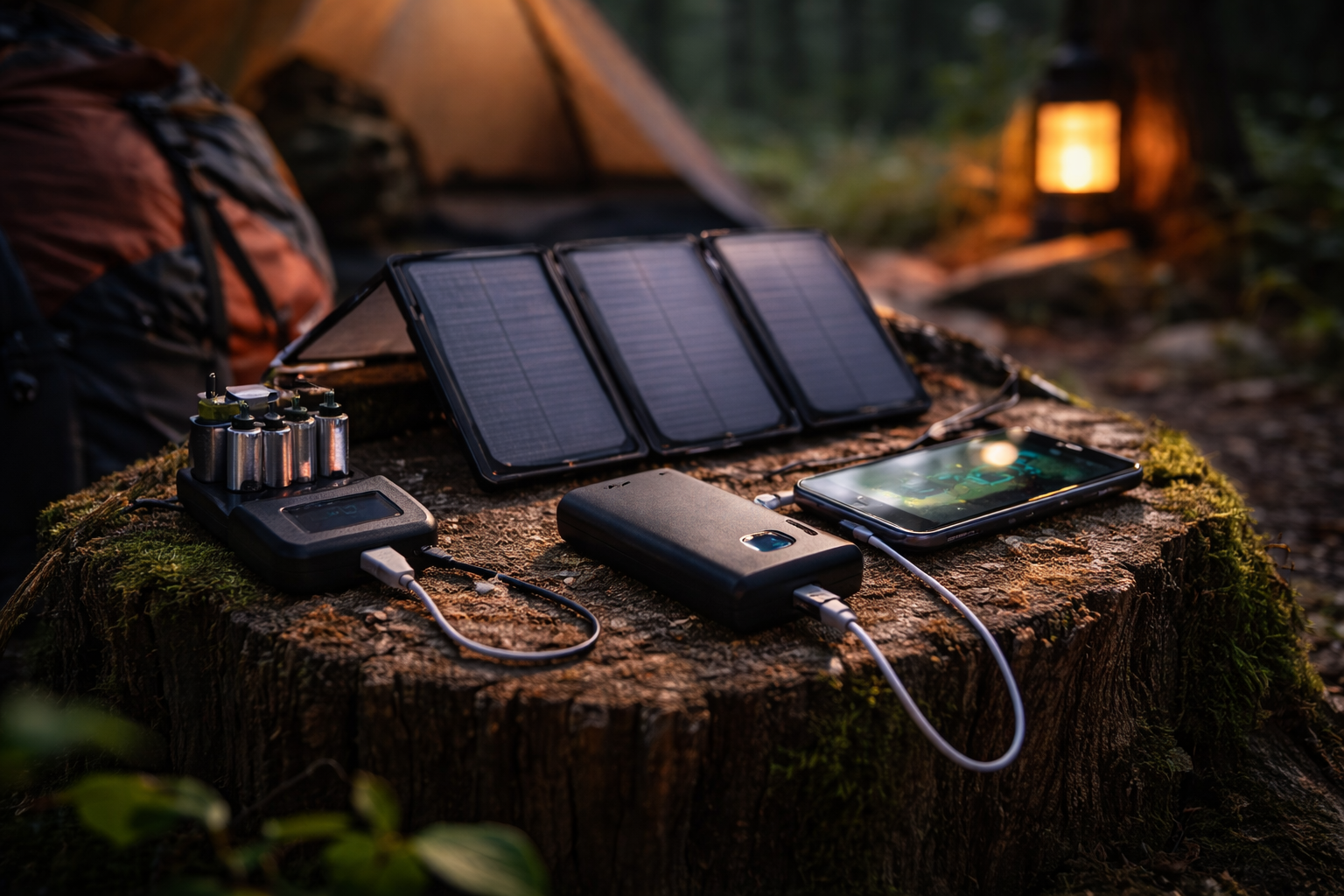
If you’ve ever watched your phone battery drop to 12% while camping, you know that small spike of panic. Maps, weather, emergency calls, photos — suddenly that little rectangle feels very important. How to charge your phone camping on a budget is something I didn’t take seriously at first… until I had to ration airplane mode like food.
The good news? You don’t need pricey solar stations or heavy power packs to stay charged. With a bit of planning and the right budget-friendly gear, you can keep your phone alive for days without stressing over every percentage point 🔋⛺️
This guide breaks down what actually works, what sounds good but doesn’t, and how to charge your phone camping on a budget without hauling half your house into the woods.
Table of Contents
- Why Phone Charging Becomes a Real Problem Camping
- My First Battery Mistake (And What I Learned)
- How to Charge Your Phone Camping on a Budget (Overview)
- Budget Power Banks: The Most Reliable Option
- Solar Chargers: When They’re Worth It (and When They’re Not)
- AA & AAA Battery Phone Chargers (Surprisingly Useful)
- Charging From Your Car (If You Have One)
- Comparison Table: Budget Charging Options
- How to Make Your Phone Battery Last Longer
- Small Accessories That Make a Big Difference
- How Lighting Choices Affect Phone Battery Life
- Final Thoughts & Quick Summary
Why Phone Charging Becomes a Real Problem Camping
Phones die faster outdoors than most people expect. A few reasons why:
- Cold temperatures drain batteries quicker ❄️
- Constant GPS use eats power
- Poor signal makes phones work harder
- Photos and videos add up fast
When you’re camping, especially on a budget, there’s no outlet waiting to save you. That’s why knowing how to charge your phone camping on a budget is less about convenience and more about preparedness.
My First Battery Mistake (And What I Learned)
On one of my early solo trips, I assumed my phone would “probably last.” It didn’t. By the second evening, I was down to single digits after checking maps and snapping photos.
I ended up turning my phone off completely overnight and only powering it on once or twice the next day. It worked, but it wasn’t ideal — and it taught me that cheap solutions are fine, but no plan at all is the expensive mistake.
How to Charge Your Phone Camping on a Budget (Overview)
At a high level, budget phone charging comes down to three practical methods:
- Portable power banks
- Small solar chargers
- Battery-based or car-based backups
You don’t need all of them. One solid option plus good battery habits usually covers most trips.
Budget Power Banks: The Most Reliable Option
If I had to recommend just one solution, this would be it.
A basic power bank is the simplest and most dependable way to charge your phone camping on a budget. No sunlight needed. No moving parts. Just plug in and go.
What to Look For in a Budget Power Bank
- Capacity between 10,000–20,000 mAh
- At least one USB-A and one USB-C port
- Solid casing (plastic is fine, rubberized is better)
Example: 10,000–20,000 mAh Power Bank
Typical cost: usually in the $18–$45 range
Material: ABS plastic, internal lithium battery
Weight: roughly 7–12 oz
Size: about a thick smartphone
Pros
- Charges most phones 2–4 times
- Works day or night
- Very predictable performance
Cons
- Needs to be charged before your trip
- Adds a bit of weight
Best for: Weekend trips, beginners, backup power
Personal note: I like knowing exactly how many charges I’ve got left — no guessing.
🔋 Anker 20000mAh Portable Charger — Honest Review

If you’re like me and rely on your phone everywhere — maps, photos, music, weather, emergency calls — then a solid power bank is one of those gear buys that just makes your life easier. The Anker 20000 mAh Portable Charger(Upgraded Version) has become my go-to backup battery when I’m out camping, traveling, or just away from an outlet for a long day.
⭐ What I Love About It
First off, the capacity is real-world useful. At about 20,000 mAh, this beast will charge most phones:
- 📱 iPhone or Android full ~3–4 times
- 🐢 smaller gadgets (Bluetooth earbuds) even more
- 📸 tablets once in a pinch
That’s great because I often take tons of photos, use GPS constantly, and still need juice left over for apps.
The charging speed is noticeable — it’s not sluggish like cheap power banks. You plug in and your phone jumps up quickly, which matters when you’re on the go. Anker’s PowerIQ and VoltageBoost tech actually make a difference — the phone doesn’t sit at 1% forever like I’ve seen with other brands.
The build feels solid and dependable. It’s not a clunky brick, and the matte finish holds up well in a backpack or pocket without getting scuffed up right away. For a 20,000 mAh pack, it’s surprisingly manageable to carry.
👍 Pros (Real Benefits I Noticed)
✔ Real capacity that delivers multiple charges — not just “advertised” numbers
✔ Fast and reliable charging — far better than cheap alternatives
✔ Dual USB outputs — can charge multiple devices at once
✔ Compact enough to travel with — not too heavy or bulky
✔ Trusted brand quality — Anker tends to last
👎 Cons (What You Should Know)
🔹 It does weigh a bit — expected at this capacity, but noticeable in a small pack
🔹 No built-in USB-C PD (on some versions) — a minor gripe if you’re into the newest ports
🔹 Takes a while to recharge itself fully
That’s really the only stuff that bugs me — and honestly, most 20,000 mAh chargers share those traits. For what you get, it’s a fair trade-off.
🧠 Who This Is Best For
- Frequent travelers: long layovers, no outlets at airports
- Campers & outdoors folks: keep phones, headlamps, cameras alive
- Everyday users: phones die quicker than we admit 😉
- People with multiple devices: tablets, earbuds, Bluetooth gear
🔌 Final Take
This Anker portable charger is one of those accessories you buy once and actually enjoy using. It hits the sweet spot of capacity, reliability, and price without gimmicks. If you’re tired of hunting for outlets, or you plan on being away from power for more than a few hours, this power bank is worthy of a spot in your backpack or day bag.
Even on a budget, keeping your phone alive should be easy — and this charger makes that happen. Highly recommended. For the price this is honestly the best all around portable power bank.
Solar Chargers: When They’re Worth It (and When They’re Not)
Solar chargers sound perfect on paper. Free energy from the sun 🌞
In reality, they’re hit or miss.
Small budget solar panels can charge a phone, but slowly. They work best as a supplement, not your only power source.
Example: Folding Solar Charger (10–15W)
Typical cost: around $25–$45
Material: fabric-backed solar cells
Weight: 8–14 oz
Size: folds down to a notebook
Pros
- Unlimited power over time
- Great for multi-day trips
- No outlet needed
Cons
- Slow charging
- Weak in cloudy weather
- Needs good sun placement
Best for: Longer trips, base camps, sunny locations
Quirk: I’ve learned not to expect miracles — it’s more of a slow drip than a faucet.
🌞 FlexSolar Folding Solar Charger & Emergency Light — Best Budget Folding Solar Charger

This is one of those pieces of gear you don’t realize how useful it is until you’re actually out there. It folds down small, weighs next to nothing, and quietly charges your phone all day using nothing but sunlight. The built-in emergency flashlight is a nice bonus for evenings around camp or unexpected situations, and the waterproof design means you don’t have to baby it when the weather turns. For budget campers, backpackers, or anyone who wants a simple off-grid charging option without extra bulk, this is an easy, practical win.
AA & AAA Battery Phone Chargers (Surprisingly Useful)
These don’t get much attention, but they’re excellent budget backups.
Battery-powered chargers use standard AA or AAA batteries to top up your phone. You won’t get a full charge, but you’ll get enough.
Example: AA Battery Phone Charger
Typical cost: roughly $10–$20
Material: plastic housing
Weight: very light without batteries
Size: palm-sized
Pros
- Batteries available almost anywhere
- Lightweight
- Cheap backup solution
Cons
- Inefficient compared to power banks
- Limited charging capacity
Best for: Emergency use, ultralight kits
Personal take: Not glamorous, but oddly comforting to have.
Charging From Your Car (If You Have One)
If you’re car camping, this is often overlooked.
- Use a 12V USB adapter
- Charge while driving
- Avoid draining your car battery overnight
It’s not always possible, but when it is, it’s essentially free power.
Comparison Table: Budget Charging Options
| Method | Cost Range | Reliability | Best Use Case |
|---|---|---|---|
| Power Bank | $18–$45 | ⭐⭐⭐⭐⭐ | Most campers |
| Solar Charger | $25–$45 | ⭐⭐⭐ | Multi-day trips |
| AA Battery Charger | $10–$20 | ⭐⭐ | Emergency backup |
| Car Charging | $10–$15 | ⭐⭐⭐⭐ | Car camping |
How to Make Your Phone Battery Last Longer
Charging is only half the equation. Conserving power matters just as much.
Simple Battery-Saving Tips
- Use airplane mode whenever possible ✈️
- Download maps offline
- Lower screen brightness
- Turn off background apps
- Avoid constant signal searching
These habits can double your phone’s lifespan between charges.
Small Accessories That Make a Big Difference
A few cheap extras help a lot:
- Short charging cables (less energy loss)
- Waterproof zip bags
- Insulated pouch in cold weather
Keeping your phone warm at night alone can save 10–20% battery by morning.
How Lighting Choices Affect Phone Battery Life
Using your phone as a flashlight is a silent battery killer. I learned this the hard way.
A small headlamp uses a fraction of the power and frees up your hands. If you’re trying to reduce how often you need to charge your phone, having dedicated lighting matters more than people think. I cover affordable, reliable options in Best Headlamp for Camping Under $30, which pairs really well with a budget charging setup.
Avoiding Costly Beginner Mistakes
A lot of battery problems come from simple mistakes:
- Forgetting to pre-charge gear
- Relying only on solar
- Using phones for light and music nonstop
I made several of these early on, and they’re surprisingly common. If you want to avoid learning the hard way, 30 Beginner Camping Mistakes to Avoid (and Easy Budget-Friendly Fixes) is worth a read — especially if you’re still dialing in your setup.
Final Thoughts & Quick Summary
Charging your phone camping doesn’t have to be complicated or expensive.
Key takeaways:
- A basic power bank covers most trips
- Solar works best as a backup
- Battery conservation is just as important
- Cheap solutions can be reliable if used right
If you’re considering upgrading your camping setup, start with power management — it quietly affects safety, convenience, and peace of mind more than almost anything else.
A little planning goes a long way out there 🌲📱
Post Disclaimer
This site contains affiliate links (including Amazon) and uses Google AdSense. Purchases through links may earn a commission at no extra cost to you. Ads may be personalized.