
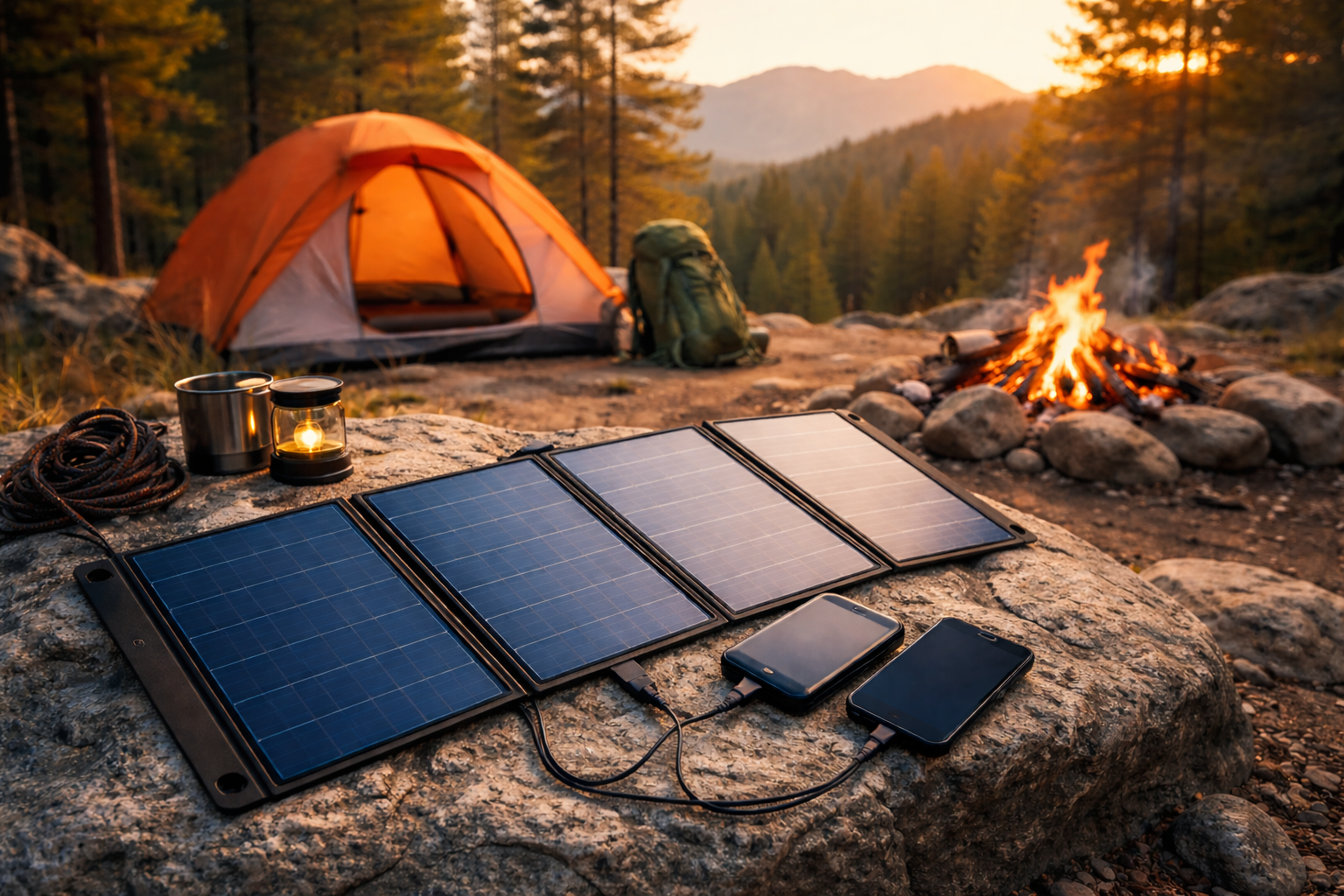
I used to think solar chargers were basically “free power in the woods” 😅. Then I actually took one camping… and learned the difference between charging and barely keeping my phone alive while it cries in the sun.
So… are solar chargers worth it for camping? Sometimes yes, sometimes absolutely not, and it mostly depends on your expectations, your camping style, and how much sunlight you realistically get where you camp.
If you’re on a budget (same), this guide is here to help you avoid buying the wrong setup and then rage-charging your phone off a car stereo like a raccoon in a parking lot.
Table of Contents
- What solar chargers actually do (and what they don’t)
- The honest pros and cons
- Solar panel vs solar power bank vs portable power station
- How much power you really need for camping
- Real-world scenarios: when solar is worth it
- My short personal solar fail (and what it taught me)
- What to look for in a good solar charger
- Mistakes that make solar “not work”
- Comparison table: solar options side-by-side
- Budget-friendly solar setups that make sense
- Quick summary + what I’d do if I were you
What solar chargers actually do (and what they don’t)
Most people buy a “solar charger” thinking it will recharge a phone like a wall outlet.
In real camping conditions, solar is more like:
- a slow drip of power (sometimes very slow),
- that depends heavily on sun strength, panel size, and how you use it.
A few truths that save money:
- Tiny panels on cheap “solar power banks” are usually maintenance trickle chargers, not serious chargers.
- Folding solar panels can work great… if you treat them right.
- Your phone charging directly from solar can be inconsistent (clouds, angle changes, heat throttling).
Solar is not magic. It’s a tool. And like any tool, it’s awesome when it matches the job.
Are Solar chargers worth it for camping if you’re on a budget?
Here’s the straight answer:
Solar chargers are worth it for camping if:
- you camp 2+ days,
- you’ll get real sun,
- and you’re trying to keep devices topped up, not run a mini apartment.
They’re usually not worth it if:
- you do overnight trips,
- you camp in deep shade / rainforest / heavy cloud seasons,
- or you want fast, predictable charging like a wall plug.
If you’re mainly trying to keep a phone alive for maps, photos, and emergencies, solar can be a smart long-term buy—but only the right style of solar.
The honest pros and cons (no hype)
Pros ✅
- Unlimited-ish power over time (as long as sunlight exists)
- Great for multi-day trips and emergencies
- Reduces the need to bring multiple heavy power banks
- Works well for low-power stuff: headlamps, phones, GPS, cameras
- Feels weirdly satisfying: you’re literally “harvesting” daylight 🌤️
Cons ❌
- Sun-dependent (shade ruins the party)
- Charging can be slow unless the panel is decent sized
- Cheap units often exaggerate what they can do
- Direct-to-phone charging can cut out randomly (clouds, heat, voltage drops)
- You still usually need a power bank as a buffer
That last point is big: solar works best when it charges a battery, and the battery charges your device.
Solar panel vs solar power bank vs portable power station
There are three “solar” categories people mix up:
1) Folding solar panels (best bang-for-buck for real charging)
These are the ones that look like little folding mats with USB ports.
- Best for: charging a power bank, phone, or small battery during the day
- Realistic: yes, these can actually work well
2) Solar power banks with tiny built-in panels (often disappointing)
These are power banks with a little solar panel glued on.
- Best for: emergency trickle, not daily charging
- Realistic: the panel is often too small to matter much
3) Portable power stations + solar panels (great, but not “budget”)
This is like a big battery box (Jackery-style) plus solar.
- Best for: car camping, long base camps, small appliances
- Realistic: amazing, but expensive and heavier
If you’re trying to keep costs low, the sweet spot is usually:
a folding solar panel + a decent power bank.
How much power do you actually need while camping?
Before buying anything, figure out what you’re powering.
Light use (most budget campers)
- Phone for photos + maps
- Headlamp
- Maybe a small Bluetooth speaker
Medium use
- 2 phones
- Action cam batteries
- Maybe a GPS communicator
- A fan (hot tent nights are no joke)
Heavy use
- Drone batteries
- Tablet
- Multiple people charging daily
- Lights running nightly
A typical smartphone battery is around 10–15Wh (varies a lot). A 10,000mAh power bank is roughly 37Wh (again, varies). That’s why a single solid power bank can cover a weekend for many people.
Solar becomes worth it when you want to extend your power bank instead of bringing three of them.
When solar is 100% worth it (real camping situations)
Multi-day hikes where outlets don’t exist
If you’re out 3–7 days, solar can be the difference between:
- “I have maps and a camera”
and - “I’m on 6% and bargaining with the universe.”
Base camping with sun exposure
If your campsite gets even a few hours of direct sun, you can top up during the day and use power at night.
Emergency preparedness
Solar is slow but dependable over time. If you keep a folding panel at home or in your car, it’s one of those “boring purchases” that becomes genius during a blackout.
You hate buying batteries
Rechargeable everything + solar feels like winning a tiny battle against the world.
When solar is NOT worth it (and will annoy you)
Dense shade camping
Forest canopy? Ravines? Rainy season? Solar can turn into a sad little decoration.
Overnight trips
If you’re out for one night, you’re better off bringing a power bank and going to sleep.
If you need fast charging
Solar can’t compete with a wall plug unless you have a bigger setup.
If you buy the wrong “solar charger”
The cheap solar power bank with a tiny panel is the considered the #1 disappointment purchase for campers, and I totally get why.
My short solar fail story (funny, but it taught me something)
The first time I tried a solar charger, I clipped it to my backpack like a proud tech wizard 🤓.
By lunch I checked my phone expecting it to be thriving.
It had gained… 1%.
Not “one bar.” Not “noticeably better.” Literally 1%.
Later I realized the panel was bouncing around, angled wrong, and half the time I was walking under trees anyway. I basically strapped a very expensive leaf to my bag and called it science.
The lesson: solar works when you stop treating it like a backpack decoration and start treating it like a camp tool—set it up flat, chase the sun, and charge a power bank, not your phone directly.
What to look for in a good solar charger (without overpaying)
For folding panels
Look for:
- 15W to 28W range for practical phone/power bank charging
- USB-A and/or USB-C output (USB-C is nicer these days)
- A way to hang or prop it facing the sun
- Solid stitching + decent weather resistance (not “waterproof,” just tougher)
Avoid:
- Panels with wildly unrealistic “fast charge” claims
- Flimsy ports with no cover
- No real reviews/photos showing use outdoors
For solar power banks
If you buy one, treat the solar panel as:
- emergency backup, not your primary charging plan.
The power bank capacity matters more than the solar panel.
Common mistakes that make solar “not work”
If someone says “solar chargers are useless,” it’s often one of these:
- Putting the panel in partial shade (even a little shade can drop output)
- Not angling toward the sun (flat on the ground is often better than hanging)
- Charging the phone directly, then clouds roll in and it disconnects
- Leaving it in extreme heat so devices throttle charging
- Expecting a tiny built-in panel to fill a big power bank quickly
A simple fix that works well:
Charge a power bank during the day, charge devices from the bank at night.
Comparison table: solar options for camping
| Option | Typical price range | Weight | Materials | Best use case | Notable pros |
|---|---|---|---|---|---|
| Folding solar panel (15–28W) | $25–$90 | 0.7–1.8 lb | Fabric + monocrystalline panels | Multi-day trips, base camps | Best real-world charging value |
| Solar power bank (tiny panel) | $15–$50 | 0.5–1.0 lb | Plastic + small panel | Emergency backup | Cheap + simple, but slow solar |
| Power bank (no solar) | $15–$40 | 0.4–0.9 lb | Plastic/aluminum | Overnight/weekend trips | Most reliable per dollar |
| Power station + solar | $200–$800+ | 5–25 lb | ABS + lithium battery | Car camping, long camps | Runs more gear, expensive |
Those price ranges shift over time, but that’s the general “real world” bracket most campers shop in.
A budget solar setup that actually makes sense
If you’re trying to stay practical, here are solid approaches:
Budget Setup A (most campers)
- 10,000–20,000mAh power bank
- Optional: folding 15–21W panel if trips are longer than 2 days
This covers:
- phone + headlamp + small stuff
without stress.
Budget Setup B (you camp 3+ days often)
- 20,000mAh power bank
- 21–28W folding solar panel
This is the sweet spot where solar starts feeling genuinely useful.
Budget Setup C (group camping)
- 2 power banks + 1 folding panel
- Rotate charging like a tiny campsite “power station” 😄
The “don’t waste money” advice I wish I had earlier
If you only remember three things from this whole article:
- Bigger panel = happier life
Tiny panels are mostly for emergency trickle. - Use solar to charge a power bank, not your phone
Phones are picky and solar is inconsistent. - Sun access matters more than brand
A cheap panel in full sun will beat a fancy panel in shade.
Also, if your whole goal is just cheap, reliable power, it’s worth reading my older guide on really good camping power banks for under $30 — it’s the fastest “no drama” solution for most weekend trips, and it pairs perfectly with solar later when you’re ready.
Quick Summary: are Solar chargers worth it for camping?
Yes—Solar chargers are worth it for camping when you’re doing multi-day trips, have decent sun exposure, and want a lightweight way to stretch your power.
No—they’re not worth it when you camp overnight, camp in heavy shade, or buy a tiny-panel “solar power bank” expecting miracles.
Extra Tip
If you’re considering solar, start simple: a decent power bank first, then add a folding panel if you’re regularly out for more than a couple nights. This is especially worth it if you camp in sunny spots and hate the feeling of watching your battery drain while you’re trying to enjoy the view 🌲🔥🏕️
Post Disclaimer
This site contains affiliate links (including Amazon) and uses Google AdSense. Purchases through links may earn a commission at no extra cost to you. Ads may be personalized.