
If you’ve ever spent a night camping where your toes felt like tiny frozen fish sticks… yeah, same. The good news is how to sleep warm camping on a budget doesn’t require a fancy “expedition” sleeping bag or a gear closet that looks like an REI aisle exploded.
Most cold nights happen because of a few simple problems: heat leaking into the ground, drafts stealing warmth, damp clothes, or going to bed under-fueled. Fix those, and you can sleep surprisingly cozy—even with budget gear 🌲🔥🏕️
Table of Contents
- Why you get cold at night (even with a “warm” bag)
- The warm-sleep system (5 budget layers)
- Layer 1: Ground insulation (the real secret)
- Layer 2: Draft control (stop the heat thieves)
- Layer 3: Clothing strategy (warm, not sweaty)
- Layer 4: Fuel + hydration (your internal heater)
- Layer 5: Cheap hacks that actually work
- My short (painfully funny) lesson learned
- Budget-friendly gear upgrades (what’s worth it)
- Common mistakes that make budget campers miserable
- Quick checklist for warm sleep tonight
- Summary + next step
Why you get cold at night (even with a “warm” bag)
Here’s the thing nobody tells you early enough: your sleeping bag isn’t the whole system.
You get cold mainly because:
- The ground sucks heat out of you faster than cold air does.
- Insulation under you gets squished flat, so it stops working well.
- Drafts steal warm air every time you move.
- Moisture makes you cold fast (sweat, damp socks, condensation).
- Low fuel = low heat. If you’re hungry or dehydrated, your body’s heater runs weak.
So yeah… you can own a decent sleeping bag and still shiver if your pad is trash or your tent is windy.
The warm-sleep system (5 budget layers)
Think of warmth like stacking cheap, simple wins:
- Ground insulation (pad setup)
- Draft control (wind + gaps)
- Clothing strategy (dry layers, no sweat)
- Fuel + hydration (your internal furnace)
- Micro-hacks (small boosts that add up)
If you nail #1 and #2, you’ll already feel like a genius.
Layer 1: Ground insulation (the real secret)
If you’ve ever been warm on top but cold on the bottom, that’s the ground working overtime.
Cheap ways to boost any sleeping pad
You don’t need a pricey winter pad to get warmer. You need more insulation under you.
1) Add a foam pad under your setup (best bang for buck)
- Put a cheap closed-cell foam (CCF) pad under your inflatable or under your sleeping bag.
- It adds insulation and protects your inflatable from punctures.
- Also: it still works if it gets wet, which is a big deal.
2) Use your backpack as leg insulation
- Slide your backpack (emptied of hard stuff) under your calves/feet.
- Legs and feet get cold fast, and this is basically free.
3) “Stuff the cold spots”
- Put spare clothes under your hips/shoulders where you compress insulation most.
- This is especially helpful on thin inflatables.
4) Site selection is free insulation
- Avoid low dips where cold air pools.
- Try to camp on dry leaves/pine needles instead of bare rock or damp dirt.
- Even moving 20 feet can change your whole night.
R-value explained like a normal human
R-value is simply how well a pad resists heat loss.
A quick mental guide:
- R 1–2: summer-ish
- R 2–4: shoulder season
- R 4+: cold nights / winter-ish
On a budget, you can “create” higher R-value by stacking:
- Foam pad + inflatable = warmer than either alone.
If you’re cold at night, don’t instantly blame the sleeping bag. It’s often the pad.
Layer 2: Draft control (stop the heat thieves)
Drafts are like that one friend who “borrows” money and never pays it back—except it’s your warmth 😅
Seal gaps and stop airflow:
- If you use a sleeping bag, cinch the hood and neck area so warm air doesn’t pump out when you roll over.
- If you use a quilt, tuck edges under you and use straps (or even a simple cord) to reduce side gaps.
Pitch your shelter smarter
- Point the narrow end of your tent into the wind.
- Stake it tight—flapping fabric increases heat loss.
- If you’re under a tarp, pitch lower on the windward side.
Ventilation, but not a wind tunnel
- Some ventilation prevents condensation, yes.
- But on cold nights: vent high (top vents) and avoid leaving a big low gap that lets wind whip through your sleeping area.
Layer 3: Clothing strategy (warm, not sweaty)
Here’s the mistake: people layer up like a winter mannequin… then sweat… then freeze.
The rule: never go to bed damp
If you get into your bag sweaty, you’ll cool down fast once you stop moving. Dampness turns into cold.
Do this instead:
- Change into dry sleep clothes (even if it’s just a dry shirt and dry socks).
- Let your skin air out for a minute before zipping up.
- Add layers gradually if you need them.
A solid budget sleep layering setup
- Base layer: thin and snug (synthetic or merino)
- Mid layer: fleece or light puffy if needed
- Bottoms: thermal leggings or joggers
- Head/neck: beanie or hood (massive difference)
- Hands: light gloves if it’s really cold
Socks are a bigger deal than people think
Cold feet ruin sleep faster than almost anything.
- Always sleep in dry socks.
- Looser socks are warmer than tight ones (tight = worse circulation).
- If your feet are still cold, do:
- thin sock + thicker sock (not both tight)
And if you want a practical breakdown of sock warmth without blowing money, this older post is worth a look: Best camping socks for cold weather — it’ll help you pick socks that actually stay warm when the temperature drops, not just “feel thick” in the store.
Layer 4: Fuel + hydration (your internal heater)
Your body is a furnace. Furnaces need fuel.
Before bed (30–60 minutes):
- Eat something with carbs + fat
- trail mix, peanut butter, crackers, oatmeal, nuts, a granola bar + some peanuts
- Going to bed hungry is basically choosing to shiver.
Hydration matters, but don’t chug a lake unless you want 2 a.m. bathroom suffering.
- Small sips through the evening help.
- Dehydration makes circulation worse, and you feel colder.
Warm drink (optional, cozy factor)
- Tea, broth, or even warm water helps you settle.
- It’s not magic, but it’s comforting and can raise your baseline warmth.
Layer 5: Cheap hacks that actually work
These are the “wow that was easy” tricks.
1) Warm up before you crawl into your bag
Do 45–60 seconds of movement:
- a short brisk walk
- a few squats
- a few pushups
Goal: warm blood flow. Not sweat. Sweat is the enemy later.
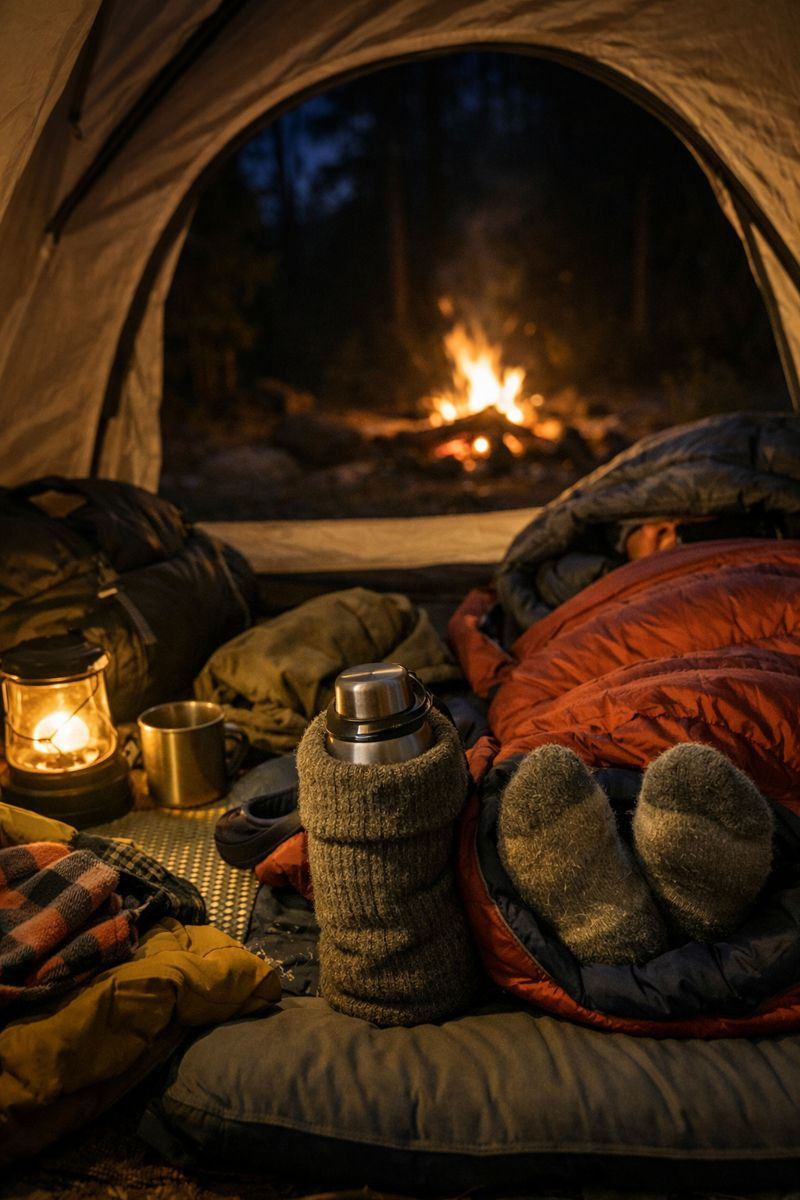
2) The hot water bottle trick (stupid effective)
This is one of the best camping warmth hacks of all time.
- Boil water.
- Pour it into a tough bottle (like a wide-mouth bottle).
- Tighten the lid hard.
- Wrap it in a sock or shirt.
- Put it near your feet or between your thighs.
You’ll feel like you’re cheating.
3) Keep tomorrow’s clothes from turning into ice
Put your socks/shirt for tomorrow in a bag and keep it near you in the sleeping bag foot area (or under your pillow). Cold clothes in the morning are a whole different kind of emotional damage.
4) Sleep with less empty space
Warmth is trapped air—but too much empty space in a sleeping bag is hard to heat.
- If your bag is roomy, wear a light layer to “fill it out.”
- Or add a liner/blanket to reduce dead air.
5) Use a cheap liner or extra blanket (strategically)
A fleece liner or light blanket can help, but:
- Don’t layer so much you sweat.
- Focus extra warmth around your core and feet first.
My short (painfully funny) lesson learned
One night I was trying to be “tough” and packed light. No foam pad, just a thin inflatable that felt fine in the living room. Around 2 a.m. I woke up cold… and I did the classic move: I blamed my sleeping bag.
So I put on every piece of clothing I owned. I looked like a sleeping burrito with anxiety. Still cold.
Turns out my inflatable had slowly leaked air, and I was basically spooning the ground. I fixed it by shoving my empty backpack under my legs and putting my jacket under my hips.
I slept better instantly—then spent the next morning acting like I meant to do that all along. Pride is a terrible sleeping bag 😂
Budget-friendly gear upgrades (what’s worth it)
This is an informational post, so I’m not going to throw a shopping list at you. But I will tell you what upgrades actually move the needle if you’re tired of rough nights.
The upgrades that matter most
- A better pad (or stacking pads)
- A warmer sleeping bag (within reason)
- Warm socks + dry base layer
- Simple draft control (quilt straps / better shelter pitch)
If you’re shopping around, these older guides will help you buy smarter without getting ripped off:
- Best Sleeping Bags Under $50 for Cold Weather — handy if your current bag just can’t keep up and you want budget-friendly options that still work.
- best sleeping pads under $30 — if you want the biggest warmth upgrade per dollar, this is usually it.
(Those are the kind of upgrades that actually change your night, not just “feel nicer” in your cart.)
Comparison table: warmth upgrades
Here’s a quick way to decide what to fix first.
| Upgrade | Typical price range | Weight | Materials | Best use case | Notable pros |
|---|---|---|---|---|---|
| Closed-cell foam pad | Low | Light–Medium | Foam | Add insulation under any setup | Cheap, tough, works when wet |
| Budget inflatable pad | Low–Medium | Light | Nylon/poly | Comfort + some insulation | Packs small, comfy (but can leak) |
| Foam + inflatable stack | Low–Medium | Medium | Foam + nylon | Cold sleepers on a budget | Big warmth boost without big spend |
| Sleeping bag liner | Low–Medium | Light | Fleece/poly/cotton | Slight warmth bump + comfort | Easy add-on, helps keep bag clean |
| Hot water bottle trick | Very low | Light | Bottle + water | Cold feet/core in any temps | Huge comfort boost, simple |
| Better cold-weather sleeping bag | Medium | Medium | Synthetic/down | When your bag is the weak link | Real warmth increase, fewer hacks needed |
| Warm base layer (sleep only) | Low–Medium | Light | Synthetic/merino | Staying dry + warm | Helps prevent sweat-chill cycle |
If you want the simplest order:
- pad/insulation, 2) drafts, 3) dry layers, 4) fuel, 5) hacks.
Common mistakes that make budget campers miserable
These are the “learned the hard way” classics:
- Sleeping directly on the ground (even in a sleeping bag)
- Wearing damp socks because “they’ll dry on me” (sometimes they do… sometimes you suffer)
- Over-layering and sweating, then freezing later
- Pitching the tent in a low cold sink because it “looked flat”
- Ignoring wind direction
- Going to bed hungry
- Not cinching the hood/neck of the bag
- Letting the pad lose air and pretending it’s fine
If you fix just two: pad insulation + dry socks. Seriously.
Quick checklist for warm sleep tonight
If you’re about to camp and want a fast plan:
- Foam pad under you (or backpack under legs if no foam)
- Tent pitched into the wind, staked tight
- Dry sleep clothes + dry socks
- Eat a small snack (carbs + fat)
- Warm up 60 seconds (don’t sweat)
- Hot water bottle near feet if cold
- Cinch hood/neck or seal quilt edges
That setup works way more often than it has any right to.
Summary + next step
How to sleep warm camping on a budget comes down to stopping heat loss, not buying fancy gear. Focus on ground insulation first, control drafts, stay dry, fuel your body, then stack a couple simple hacks like the hot water bottle trick.
If you’re considering upgrading anything, it’s especially worth it to start with your sleeping pad and your sleeping bag rating, since those two pieces do the heavy lifting. And if you want help buying smart without wasting money, the linked guides on budget sleeping bags, sleeping pads, and cold-weather socks are a good next step.
Post Disclaimer
This site contains affiliate links (including Amazon) and uses Google AdSense. Purchases through links may earn a commission at no extra cost to you. Ads may be personalized.