
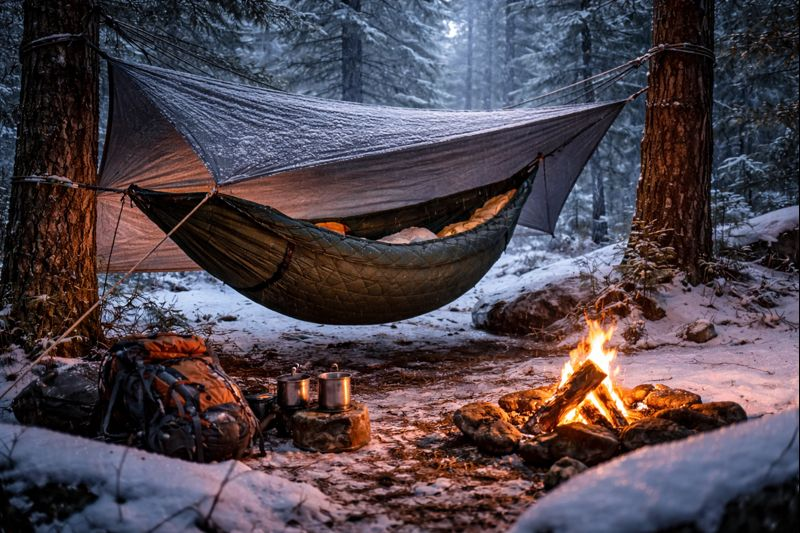
How Cold Is Too Cold for Hammock Camping?
That’s the question I asked myself the first time I woke up at 2:30am shivering like a cartoon character, staring into the dark, thinking… okay, this was a dumb idea 😅.
Here’s the honest truth: hammock camping in cold weather is absolutely possible, but the “too cold” line isn’t a single number. It depends on your insulation underneath you, your wind exposure, your sleep system rating, and even how you eat before bed. The ground steals heat, sure — but in a hammock, air steals heat even faster.
In this guide, I’m going deep on How Cold Is Too Cold for Hammock Camping? — what temperature ranges are realistically safe, what gear matters most, and how to avoid the classic cold-hammock mistakes that ruin a night outdoors 🌲🔥🏕️.
Table of Contents
- The Real Answer: How Cold Is Too Cold for Hammock Camping?
- My Cold Hammock Camping Mistake (So You Don’t Repeat It)
- Why Hammocks Feel Colder Than Tents
- The Temperature “Red Zones” (Quick Chart)
- What Actually Keeps You Warm in a Hammock
- Underquilts vs Sleeping Pads
- Sleeping Bag vs Top Quilt
- Wind Protection and Tarps
- Clothing Strategies That Work (and Ones That Backfire)
- Cold Weather Setup Tips (Site Selection Matters)
- Common Cold Hammock Camping Mistakes
- Hammock vs Tent in Cold Weather (Budget Reality Check)
- Final Thoughts
The Real Answer: How Cold Is Too Cold for Hammock Camping?
For most campers on a normal budget, around 40°F / 4°C is where hammock camping starts to get “serious.” Below that, your comfort depends heavily on whether you have proper bottom insulation (underquilt or insulated pad).
Here’s a practical way to think about it:
- Above 50°F (10°C): Easy for most people
- 40–50°F (4–10°C): You need bottom insulation, even if you “run warm”
- 30–40°F (-1–4°C): You’ll want a real underquilt (or a very good pad) + wind protection
- Below 30°F (-1°C): Possible, but mistakes get expensive fast
- Below 20°F (-6°C): Not beginner territory (you need dialed gear and experience)
So if you’re asking “How Cold Is Too Cold for Hammock Camping?” the real answer is:
✅ If you have solid bottom insulation + wind protection, 30°F can be fine.
❌ If you don’t, even 50°F can feel miserable.
My Cold Hammock Camping Mistake (So You Don’t Repeat It)
I once went out on a cool night that didn’t seem that bad on paper — low 45°F, light breeze. I brought a decent sleeping bag and a hoodie and figured I’d be cozy.
What I didn’t bring? Proper insulation under me.
I lasted maybe an hour before the cold started creeping in, like someone slowly turning a dial. My back and butt felt cold first, then the chill crawled up my spine. I tried curling into a ball, tightening the sleeping bag, even doing that weird “hammock cocoon wiggle.” Nothing worked. The air under me was just stealing heat nonstop.
That night taught me the most important cold-hammock lesson:
Top warmth doesn’t matter if your underside is losing heat.
Why Hammocks Feel Colder Than Tents
In a tent, the ground can be cold, but at least it’s stable. In a hammock, you’re surrounded by moving air, and that air strips heat away.
Three reasons hammocks feel colder:
- Convection under your body
Cold air flows beneath you and carries warmth away constantly. - Compression kills sleeping bag insulation
The sleeping bag loft under you gets squashed flat. Flat insulation = almost no insulation. - Wind turns “cool” into “brutal”
A mild breeze at 45°F can feel wildly colder in a hammock than inside a tent.
That’s why “How Cold Is Too Cold for Hammock Camping?” can’t be answered without talking about under-insulation.
The Temperature “Red Zones” (Quick Chart)
| Night Low Temp | Beginner-Friendly? | What You Need to Be Comfortable |
|---|---|---|
| 60–50°F (15–10°C) | ✅ Yes | Light blanket or 50–40°F bag + basic pad (optional) |
| 50–40°F (10–4°C) | ✅ Mostly | Under-insulation (pad or light underquilt) + decent bag |
| 40–30°F (4–-1°C) | ⚠️ Depends | Real underquilt or insulated pad + wind blocking tarp |
| 30–20°F (-1–-6°C) | ❌ Not for most | Warm underquilt + top quilt/bag + careful site selection |
| Below 20°F (-6°C) | ❌ Advanced | Winter-rated system, experience, and zero shortcuts |
What Actually Keeps You Warm in a Hammock
Underquilts vs Sleeping Pads
If you take nothing else from this article, take this:
Under insulation matters more than top insulation.
Underquilt (best comfort)
An underquilt hangs under the hammock so the insulation stays fluffy and doesn’t compress. It wraps warmth around you and feels… honestly pretty luxurious when it’s cold.
Pros
- Warmer and more consistent
- No slipping around
- No cold “shoulder gaps” if fitted well
Cons
- Costs more
- Takes practice to set up right
Sleeping Pad (budget-friendly)
Pads can work, especially if you’re trying to keep costs low. But they can shift, and some hammocks feel awkward with pads.
Pros
- Cheap and multipurpose
- Works in a tent too
- Easy to find
Cons
- Slides around (especially at night)
- Can cause sweaty back
- Cold gaps around shoulders/hips
If you’re starting out and asking “How Cold Is Too Cold for Hammock Camping?” — a pad might get you through cool nights, but below 40°F, most people prefer an underquilt for sanity.
Sleeping Bag vs Top Quilt
Either works, but here’s the deal:
- A sleeping bag is easier for beginners
- A top quilt is more comfortable once you’re used to hammocks
A sleeping bag can feel tight in a hammock. A top quilt drapes nicely and lets you move without wrestling a zipper in the dark. But if you’re on a budget, use what you already have. Here you can find 7 of the best sleeping bags for warmth when camping on a budget.
Wind Protection and Tarps
Wind is the sneaky killer. Even with good insulation, wind can find little gaps and drain warmth.
To reduce that:
- Pitch your tarp lower in cold weather
- Use doors if your tarp has them
- Set up behind natural windbreaks (trees, rocks, terrain)
If your tarp is high and open like a beach umbrella, you’re basically inviting wind to move in. You can check out my reviews and recommendations on the best tarps under $30 for camping.
Clothing Strategies That Work (and Ones That Backfire)
This part is surprisingly misunderstood.
What usually helps
- Dry base layers (this is huge)
- Warm socks (clean and dry)
- Beanie or hood (your head really matters at night)
- Light puffy jacket if needed
What often backfires
- Wearing too many tight layers (compresses insulation)
- Going to bed sweaty (you’ll get cold later)
- Cotton anything (it holds moisture and turns chilly fast)
One weird tip that works:
If you’re cold, don’t immediately pile on clothes. First, check your underside insulation and tarp pitch. Half the time, the “cold” is coming from below or wind.
Cold Weather Setup Tips (Site Selection Matters)
Where you hang can change your night from comfy to miserable.
Look for:
- Slightly lower wind areas (but not in a water-collecting dip)
- Dense tree cover
- Natural windbreaks
- Dry ground (less moisture = less chill in the air)
Avoid:
- Ridge tops and open areas
- Valleys where cold air settles
- Spots near water when it’s cold (more humidity, more chill)
Cold air pools like water. It’s sneaky like that.
Common Cold Hammock Camping Mistakes
Here are the “classic” ones I see (and I’ve done a few myself, sadly):
- No bottom insulation (the #1 mistake)
- Tarp pitched too high in windy conditions
- Assuming sleeping bag rating = comfort rating
- Not eating before bed (your body needs fuel to make heat)
- Going to bed damp from sweat or rain
Also, don’t underestimate a warm drink. Even plain hot water can feel like a little reset button inside you ☕.
Hammock vs Tent in Cold Weather (Budget Reality Check)
Cold weather is also where the “hammock vs tent” debate gets real. Hammocks can be incredibly comfortable, but tents can be more forgiving when it’s chilly and wet, especially if your hammock setup isn’t dialed yet.
If you’re deciding which route makes the most sense for your budget and climate, I broke it down in a way that’s actually practical (not theory) in Hammock vs Tent for Budget Camping. It helps a lot if you’re trying to choose one main setup without wasting money.
Final Thoughts
So… How Cold Is Too Cold for Hammock Camping?
For most people, the “danger zone” starts when they go below 40°F without proper bottom insulation. With a good underquilt (or a solid insulated pad), a well-pitched tarp, and smart site selection, hammock camping can still be cozy into the 30s — even lower if you really know what you’re doing.
If you’re considering trying hammock camping in colder temps, this is especially worth it if you start small: test it near home first, learn what your body needs, and don’t be afraid to adjust. Cold nights teach fast lessons… sometimes a little too fast 😄🌲🔥
Post Disclaimer
This site contains affiliate links (including Amazon) and uses Google AdSense. Purchases through links may earn a commission at no extra cost to you. Ads may be personalized.